

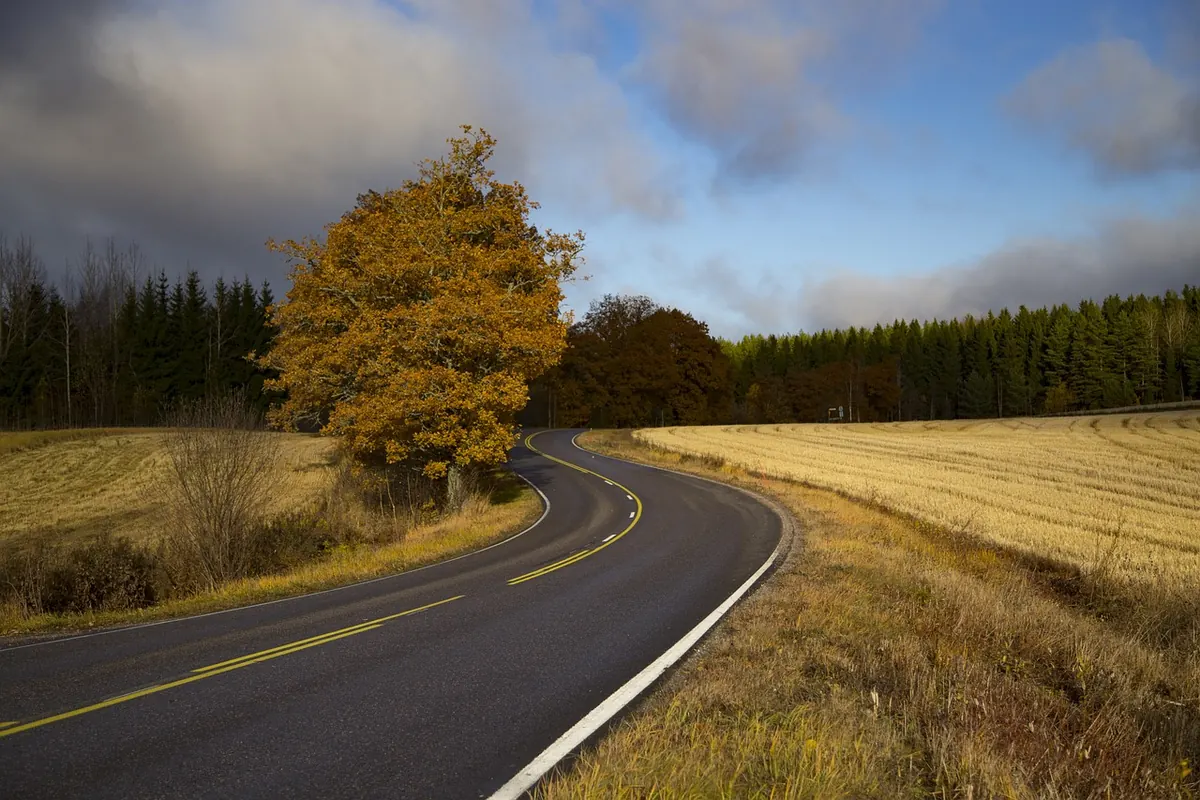
Dorset in autumn is a different county. The crowds thin after the school holidays, the hedgerows fill with hips and sloes, and the beech woods on the chalk start turning. What makes it good for drivers is the variety. You can be up on a ridge with the Blackmore Vale spread out below you and, twenty minutes later, be down in lanes where the trees close overhead, the verges are wet with dew, and the only traffic is a tractor with a trailer of straw. Nothing is very far from anything else, which means you can build a day around a twenty-mile stretch of road and still fill it. These five routes are worth planning a day around.
1. The B3157: Bridport to Weymouth
The coast road between Bridport and Weymouth is short, around twenty miles, and about forty minutes if you never stop. You will stop. From Burton Bradstock the road climbs and dips along the top of the cliffs, with Chesil Beach running away east and the Fleet behind it, a thin silver line of water held in by a shingle bank that stretches for eight miles.
Autumn suits this road better than summer. The light comes in low from the south, the bracken on the cliff tops goes rust, and swallows and martins gather along the coast before heading off. On a clear October morning the sea is a hard, bright blue and the fields behind the road are still green, which makes the whole thing look slightly over-saturated. By four o'clock the sun is already dropping behind the hills and the beach turns the colour of pale tea.
Photo stops:
- Hive Beach at Burton Bradstock, with a car park, a café and cliffs that catch the afternoon sun.
- West Bexington, where a short walk over the shingle brings you to the Fleet at its quietest.
- Abbotsbury, where the Swannery and the Subtropical Gardens run reduced winter hours, so check before you set off.
- The high ground above Portesham, looking back west along the beach.
Allow three hours with stops, or a full day if you walk any of it. The road is wide enough for two cars almost everywhere, but it is popular with cyclists and the bends above West Bay are blind, so take them slowly.
2. Cranborne Chase: Wimborne to Win Green
Take the B3078 north-west out of Wimborne through Horton and Woodlands to Cranborne, then pick up the lanes towards Tollard Royal, Ashmore and Win Green. This is chalk downland and old woodland, and it is where Dorset's autumn colour arrives first.
Beech is the star. The hangers, woods clinging to the steep chalk slopes, turn copper and gold from early October, and the lanes run between high banks that hold the leaves long after the trees above them have shed. There is a reason painters keep coming back here: the beech trunks go grey-green with moss in the damp, and the light that gets through the canopy is oddly soft, even at midday.
Ashmore is worth a pause. It sits at the top of the downs around a small pond, and at eight hundred feet it is one of the highest villages in the county. From there the road climbs to Win Green, the highest point of Cranborne Chase, where a National Trust car park gives you a view over four counties on a good day. Take a coat. The wind up there arrives from nowhere.
Don't miss:
- Tollard Royal, with its thatched cottages and the Larmer Tree Gardens nearby.
- The lane between Ashmore and Fontmell, which drops through beech hangers in long curves.
- Cranborne village, where the church and the old manor walls catch the late sun.
Allow half a day. The roads are narrow in places and often single-track, so keep an eye out for passing places.
3. Bulbarrow Hill and the Blackmore Vale
From Blandford Forum take the B3092 north towards Sturminster Newton, then turn off and climb to Bulbarrow Hill. It is 274 metres up and the view is the point: the Blackmore Vale laid out like a map, patchwork fields, hedgerow oaks, and church towers poking up out of the mist that collects in the valley on still autumn mornings.
The descent towards Milton Abbas is the best part of the drive. The lane drops steeply through beech woods, and then the village appears below you, a single street of white thatched cottages built in the 1770s to move the townsfolk out of sight of the big house. The chestnut avenue leading to Milton Abbey is at its best in the third week of October.
Loop back through Hilton, Ansty and Ibberton for more ridge views, or stop in Sturminster Newton, where the old mill and the bridge over the Stour make a good end to the day.
If you only do one ridge in Dorset in autumn, do this one. Go early, before the mist lifts.
4. Purbeck: Wareham, Corfe and Kimmeridge
The Isle of Purbeck is not really an island, but it drives like one. Start at Wareham, follow the A351 through Corfe Castle, then take the lane up to Kingston and along the ridge. From the top you look down on Corfe's ruined keep on one side and across to Poole Harbour on the other.
Autumn here is about the heath. The heather has gone over but the bracken, birch and larch take up the colour instead, and the low sun picks out every ridge and hollow. Kimmeridge Bay is reached by a toll road and has a car park above the bay, a marine centre and ledges of shale that are slippery when wet. Tyneham, the village emptied in 1943 and never given back, is open on limited days only, so check the ranges before you plan around it.
Worth the detour:
- The lane from Kingston to Swyre Head, one of the highest points on the Purbeck ridge.
- Arne, for red deer, heathland and views over the harbour.
- Studland and Shell Bay, where you can take the chain ferry back to Sandbanks.
5. Shaftesbury, Zigzag Hill and the Stour Valley
Shaftesbury gives you Gold Hill, the cobbled climb made famous by a bread advertisement, and from the top the view stretches over the Blackmore Vale. But the drive itself starts on the B3081 west of town, at the top of Zigzag Hill.
Zigzag Hill is one of the oddest pieces of road in the south of England: a series of tight hairpins cut into a steep chalk slope, climbing through beech woods with barely room for two cars to pass. It is not a road for a large vehicle or a nervous passenger, and it is not a road for speed. First and second gear, brakes warm, and take the corners properly. In mid-October the whole slope is orange.
Beyond it the road runs through Melbury Abbas and Fontmell Magna, under Melbury Down and Fontmell Down, two more beech hangers that turn late and hold their colour into November. Round it off at Compton Abbas airfield, where the café looks out over the vale and small planes come and go on fine afternoons.
Practical Notes for an Autumn Drive in Dorset
A few things are worth knowing before you set out, because autumn conditions change fast and some of these lanes are less forgiving than they look.
- Daylight. After the clocks go back, sunset is around 4.30pm by the end of October. Plan to be off the narrow lanes by half past four, or carry a torch and know where you are going.
- Wet leaves and mud. Wet beech leaves on tarmac are as slippery as ice, and farm traffic leaves mud on the road all through the autumn. Slow down before the bend, not in it.
- Deer and livestock. Deer move at dawn and dusk, especially around Cranborne Chase and Purbeck. Cattle and sheep graze the open commons and are not fenced.
- Single-track lanes. Use passing places, and pull in on your left. Do not reverse into a hedge if you can avoid it.
- Hedge-cutting. Late September and October are cutting season. Expect tractors, flails and thorns on the road.
- Fuel and signal. Fill up in a town before you start. Phone signal is patchy in the valleys and on the ridges.
Where to Stop for Lunch and Tea
Dorset does this well, and it is half the reason for the drive. The Anchor at Seatown sits under Golden Cap, a few minutes off the B3157. The Ilchester Arms at Abbotsbury is handy for the Swannery. In Purbeck, the Square and Compass at Worth Matravers serves cider and pasties and has done for centuries, and the Bankes Arms at Studland is right on the water. North of Blandford, the Crown at Marnhull is a good stop on the Blackmore Vale loop, and Compton Abbas airfield café is the obvious one for the Shaftesbury route.
Hours shrink in autumn, and some kitchens close between three and six. Ring ahead if you are building the day around a meal.
Planning the Day
You cannot sensibly do all five routes in one trip, and you would not want to. Pick two that sit near each other, do one properly in the morning, stop for lunch, and do the second in the softer light of the afternoon. Pack a flask, a pair of boots and a waterproof, and leave the timetable loose. The best moment on any of these roads is usually the unplanned one: a gateway you pull into, a view you did not expect, a lane that goes somewhere you had not heard of.
Photo: juhasuhonen1 / Pixabay